Is a Custom Suit Worth It?
Every rider who has considered a custom motorcycle suit has asked the same question: is the premium worth paying? The honest answer is that it depends entirely on what you understand the premium to actually be buying — and most riders, when they look closely, find that the gap between off-the-rack and custom is far larger than the price difference suggests.
This is not a dismissal of off-the-shelf gear. At the right price point, a well-chosen off-the-rack suit from a reputable manufacturer is a legitimate choice for many riders. But it is a choice with specific limitations — in fit, in materials, in protection placement, and in identity — that a custom-built suit is specifically designed to eliminate.
Understanding those limitations clearly is the only way to make a genuinely informed decision. That is what this guide does.
"An off-the-rack suit is built for a statistical average. A custom suit is built for you. At speed, that difference is not cosmetic — it is structural."
A Veloce custom commission — every panel, protection zone, and graphic built around one specific rider
Fit — The Gap That Cannot Be Closed with Sizing
Off-the-rack suits are cut to a standardised size block — a set of proportions derived from population averages. The block assumes a specific relationship between chest, waist, hips, arm length, torso length, and inseam. If your body matches that block closely, an off-the-rack suit can fit well. Most riders' bodies do not match any single block closely.
The consequence of poor fit in motorcycle gear is not aesthetic — it is mechanical. A suit that is too long in the torso will bunch at the waist when a rider crouches on the bike, pushing the back protector upward and out of position. A suit with sleeves cut too short will expose the wrist in a crash. A suit with a chest block too wide for the wearer's frame will allow the shoulder armour to sit lateral to the shoulder joint rather than over it — exactly where it needs to be.
A custom suit begins with a full set of body measurements — 12 to 16 dimensions depending on the manufacturer — and a set of riding-position measurements taken in the crouch the rider actually uses. The pattern is constructed around those specific numbers. Armour positions are mapped to the rider's body, not to a generic block.
At Veloce, we ask customers to send measurements both standing and in riding position — because a suit that fits correctly standing tells us nothing about how it fits on the bike. The bike position is where it needs to work.
Custom suit sizing takes 12–16 body measurements — both standing and in riding position — to ensure armour sits correctly on the bike
Protection Placement — Where the Armour Actually Sits
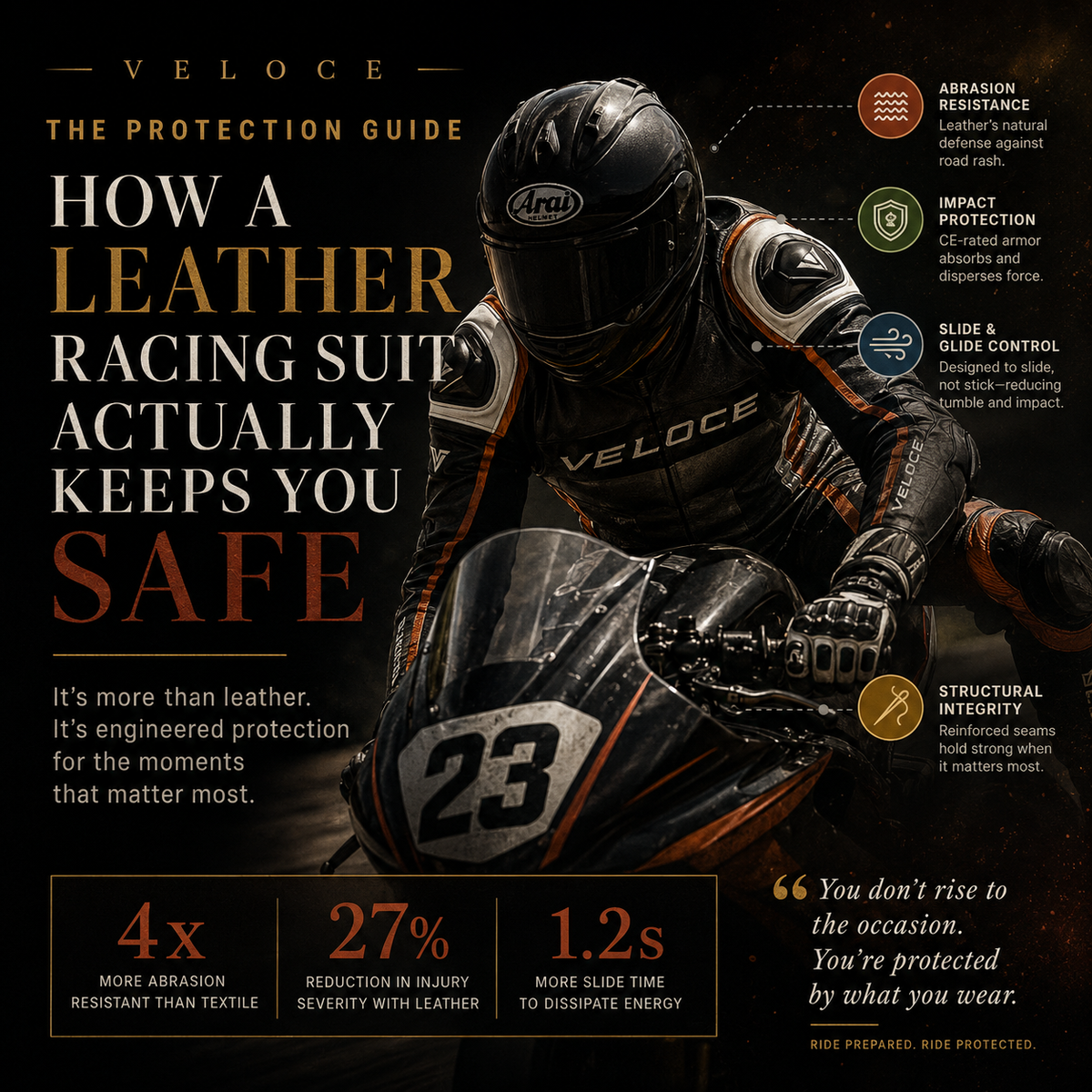
This is the difference most riders overlook, and arguably the most important one. CE-rated armour only protects the body part it covers. Armour that has migrated two centimetres away from the knee joint protects the knee significantly less than armour positioned correctly. Shoulder armour that sits lateral to the shoulder because the suit's chest block is too wide protects the shoulder joint far less effectively than centralised armour.
Off-the-rack suits position armour for the average body within the size block. If your proportions deviate from the block — longer arms, wider shoulders relative to chest, shorter torso — the armour deviates from your impact zones proportionally. This is not a flaw in any particular manufacturer's design; it is an inherent limitation of designing for an average.
In a custom suit, every armour pocket is positioned after the measurements are taken — mapped to the rider's actual shoulder width, actual elbow position in riding posture, actual knee location. The protection is where your body is, not where the average body is.
- Shoulder armour centred over the glenohumeral joint, not the size-block average
- Elbow armour positioned at the rider's actual elbow in riding crouch
- Knee armour mapped to the rider's knee joint with the leg bent at riding angle
- Back protector channel length matched to the rider's torso — no upward migration in crouch
- Hip armour pockets placed at the iliac crest, not at a standard waistband position
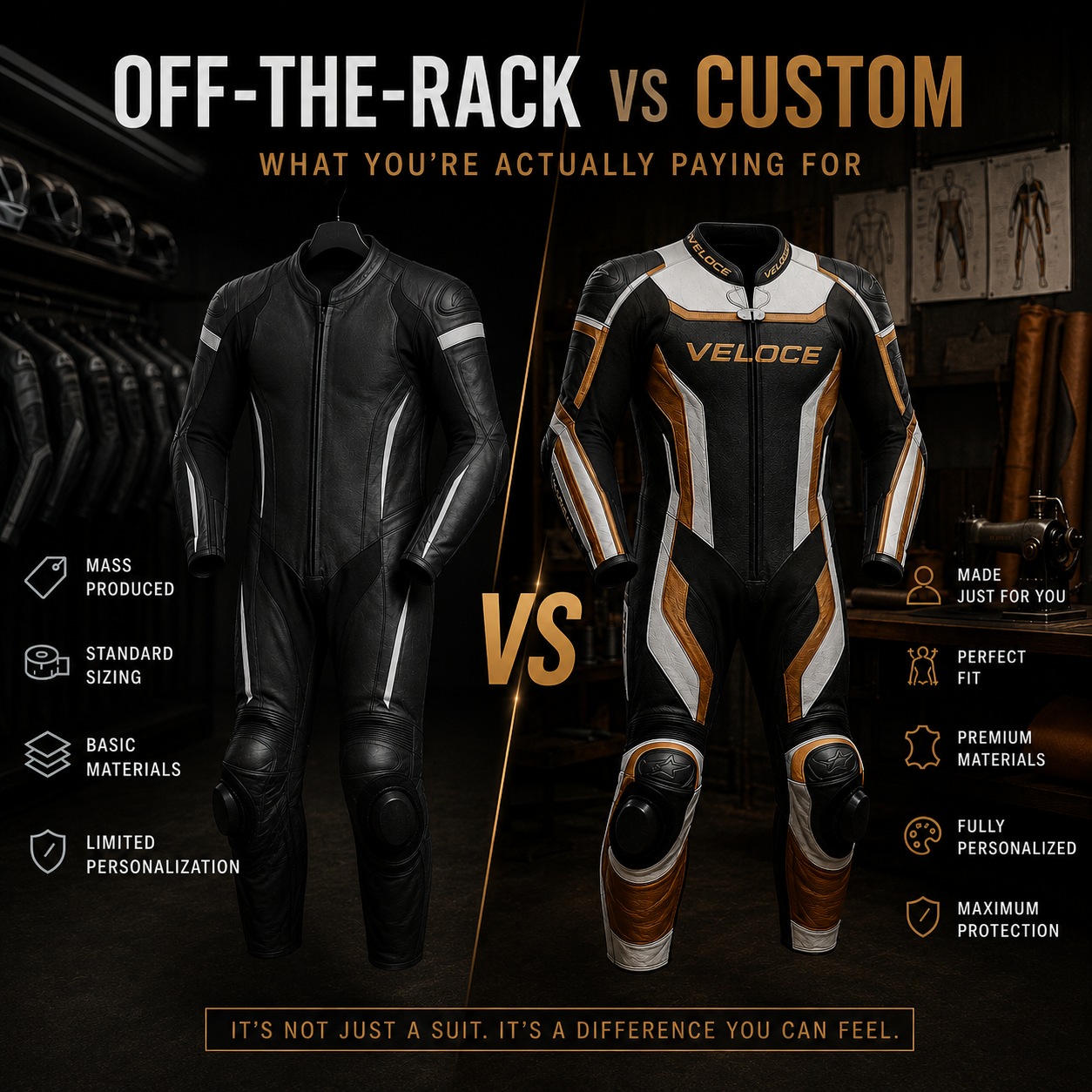
The Honest Comparison
How off-the-rack and custom suits compare across the factors that matter most to a serious rider.
Materials — What the Price Point Dictates
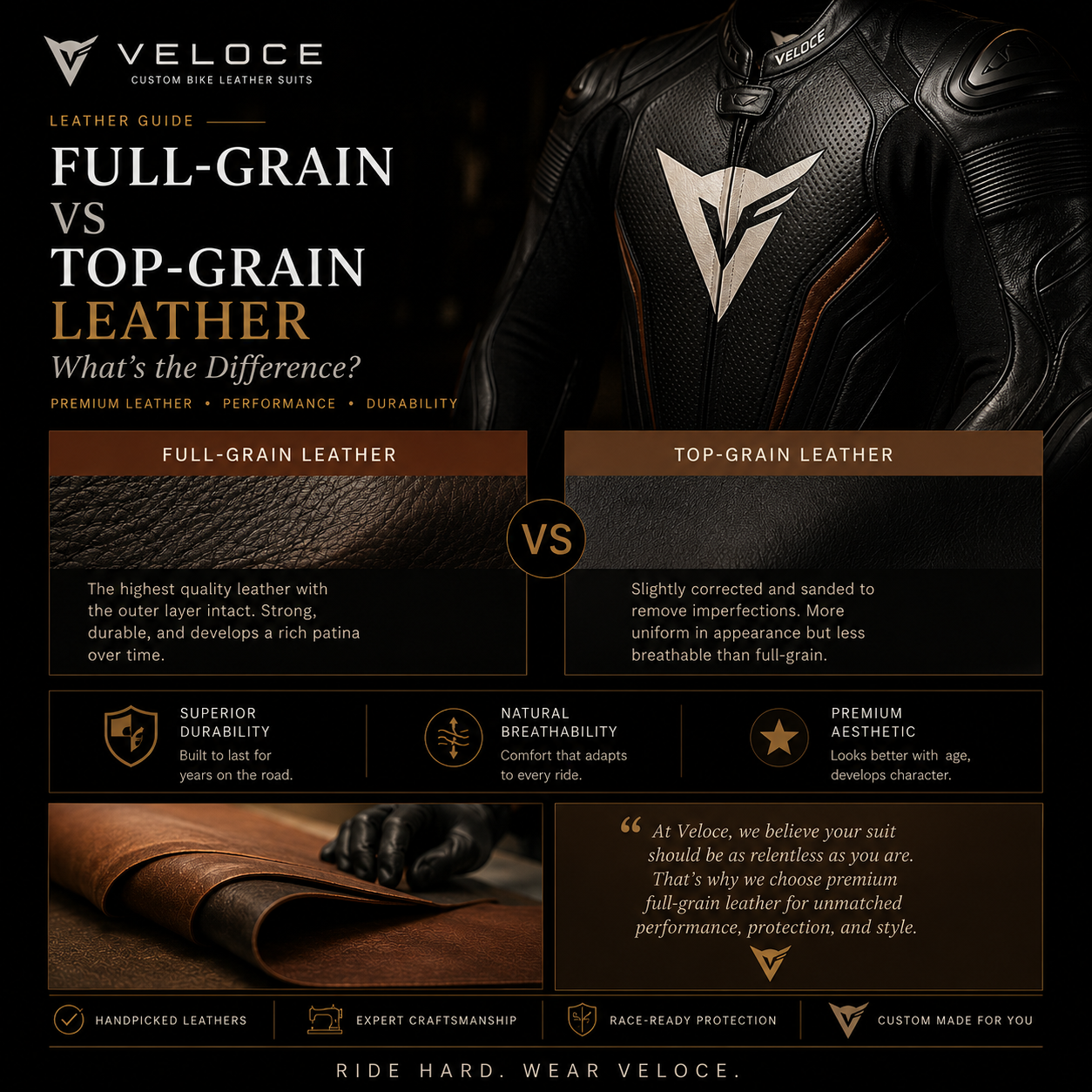
Leather quality is the first variable that commercial pressure reduces in off-the-rack production. Full-grain cowhide is the most protective and most expensive option. Top-grain cowhide — buffed to remove natural imperfections — is cheaper, looks more uniform, and performs measurably worse under abrasion. Split leather is cheaper still and has no place in protective gear.
At the mid-to-lower price tiers of the off-the-rack market, it is common to find suits using top-grain or split leather on non-visual panels while reserving better hides for externally visible areas. This is a commercial decision, not a protection decision — and it means the panels most likely to contact tarmac in a crash may not be using the most abrasion-resistant material available.
A custom suit built to a specified material brief uses the same grade of leather across all structural panels because the person commissioning the suit is also the person wearing it. There is no incentive to reduce material quality on a panel that will not be seen in a shop.
Veloce suit construction — hand-finished seams, full-grain panels throughout, and Kevlar-reinforced thread on every structural join
Identity — The One You Cannot Buy Off a Shelf
Every rider who steps onto a circuit in an off-the-rack suit shares their colourway with thousands of other owners. That is a factual statement, not a criticism. But for riders who approach their gear as an extension of their racing identity — their number, their colours, their sponsor branding, their national flag, their personal signature — off-the-shelf simply cannot deliver what a custom commission can.
At Veloce, the design process begins with a conversation about the rider's identity. Racing number, national colours, team livery, personal sponsor branding, a colourway matched to the bike — these are design inputs, not afterthoughts. The graphic execution uses laser-cut leather inlay, heat-transfer sublimation, and embroidery in combination, producing results that are tactile, permanent, and uniquely yours.
The Swiss project you may have seen on this blog is a direct example: Union Jack colouring, racing number 88 embroidered on the gloves, a complete four-piece kit built around one rider's visual identity. That is not something you find in a size medium on a shop rail.
Every MotoGP suit is built custom — sponsor branding, rider number, team colours, and personal details specific to one individual
When Off-the-Rack Is the Right Answer
There are genuine scenarios where an off-the-rack suit from a reputable manufacturer is the correct choice — and it is worth being straightforward about them.
You Need Gear Immediately
Valid ReasonA custom suit takes 4–6 weeks to build from measurement sign-off. If you have a track day in two weeks, an off-the-rack suit from a quality manufacturer is the appropriate solution. Riding in well-specified off-the-rack gear is always better than riding without it.
Your Body Matches the Size Block Closely
Valid ReasonSome riders genuinely fit a standard size block well — proportions that correspond closely to the manufacturer's template. If a trial fitting confirms that armour sits correctly in riding position and the suit moves without binding, the fit argument for custom weakens considerably. The materials and design arguments remain.
Budget Is the Primary Constraint
Valid ReasonA well-specified off-the-rack suit at a price point the rider can comfortably afford is a better decision than a custom commission that stretches finances. Good protection you can actually buy is always the correct choice. Veloce custom commissions are an investment — they should be made when the timing and budget are right, not under financial pressure.
The Veloce Custom Commission Process
For riders who decide a custom suit is the right choice, here is exactly what the Veloce commission process looks like — from first contact to the suit arriving at your door.
Design Brief & Consultation
We start with a conversation — by email, WhatsApp, or video call depending on your preference. We discuss your riding, your visual identity, your protection requirements, and your timeline. No templates, no tick-box forms. A genuine brief.
Measurements
We send a detailed measurement guide. You take 12–16 measurements standing and in riding position, following our step-by-step instructions. For customers who prefer in-person measurement, we can arrange a fitting session — contact us to discuss availability.
Design Visualisation
Based on the brief, we produce a digital visualisation of the suit design for your review and approval. Colour panels, graphic placement, badge and embroidery positions — all confirmed before a single panel is cut. Revisions are made at this stage, not after production has started.
Pattern Cutting & Build
Once design is signed off, production begins. Leather is selected from stock, panels are cut to the personal pattern, armour pockets are positioned to the measurement map, and the suit is assembled and finished in our workshop. Build time is 4–6 weeks from sign-off.
Quality Check & Dispatch
Every completed suit is checked against the original specification before dispatch — seam integrity, armour placement, zipper operation, graphic accuracy, and overall finish. A leather specification card documenting the hide grades and protection specifications ships with the suit. International shipping is available to all markets.
A correctly fitting custom suit moves with the rider — no binding, no bunching, and armour exactly where it needs to be when the position changes
What You Are Actually Paying For
The price difference between a quality off-the-rack suit and a Veloce custom commission is real. What it buys is equally real: a pattern built around your body, armour positioned over your impact zones, full-grain leather on every structural panel, seams that will not fail under crash loads, and a design that belongs to no one else.
For riders who take their time on track seriously — who invest in their bike, in their training, in their tyres — a custom suit is the logical conclusion of that investment. The gear you trust your body to should be built for your body.
Every Veloce commission comes with a full leather specification card, a lifetime repair service, and the knowledge that every decision made during the build was made for you specifically — not for a size block average.