A Racing Suit Is an Engineering Decision
Most riders buy a leather suit because it looks serious. The best riders buy one because it is serious. There is an enormous difference between gear that performs when it matters and gear that merely resembles gear that performs.
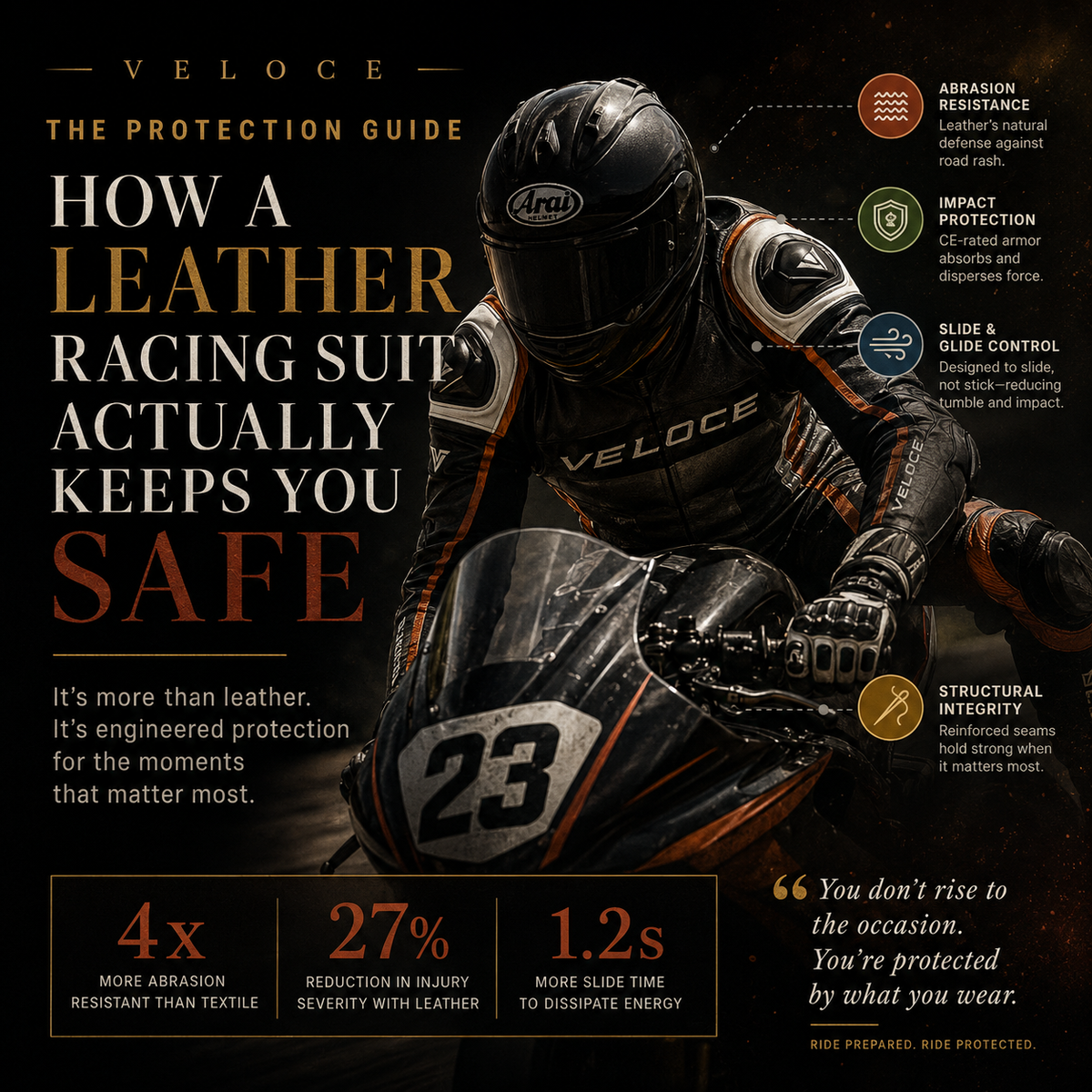
A modern leather racing suit is a layered protection system — not a single product. At least three distinct defence mechanisms work together the moment a rider hits tarmac: the leather shell absorbs and distributes abrasion energy, the armour inserts absorb and redirect impact forces, and the suit's construction keeps everything in place under the forces of a real crash.
Understanding each layer — what it does, how it is rated, and what separates good from great — is the difference between buying a suit that looks safe and one that actually is.
"In a high-speed slide, a rider's suit contacts the tarmac for up to three seconds. Every material decision made during construction is tested in those seconds."
CE-rated leather racing suits are tested against EN 17092 — the European standard covering abrasion, impact, and seam burst resistance
The Leather Shell — Your First Defence
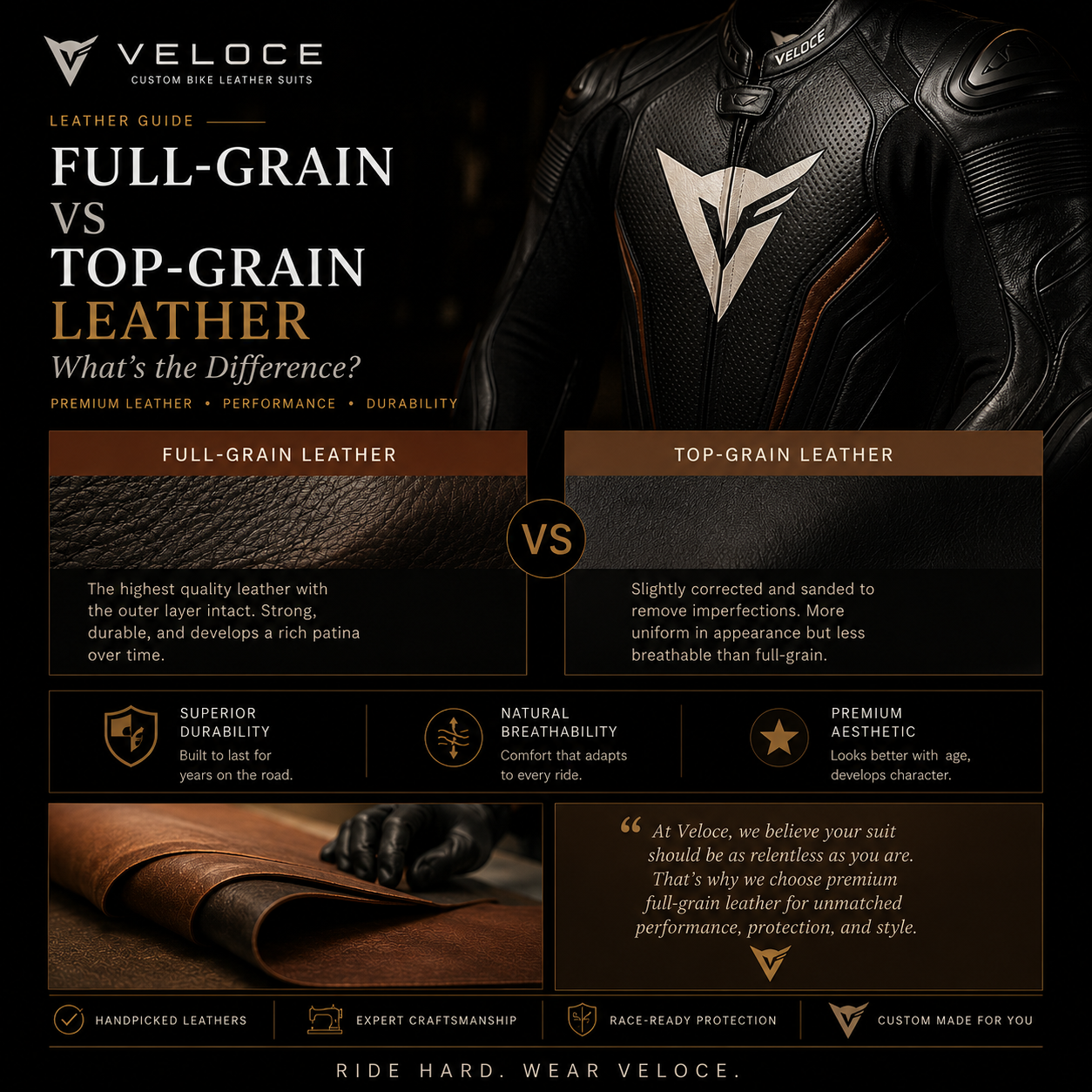
The outer leather is the first material to engage in a crash. Its job is two-fold: resist tearing (so the layers beneath stay in place), and absorb abrasion energy through controlled surface wear rather than catastrophic failure.
This is why leather remains the dominant material for racing suits over textile — no synthetic fabric matches its combination of abrasion resistance, tear strength, and comfort at equivalent weight. Full-grain cowhide at 1.2mm can sustain a slide of over 70km/h without breach. Kangaroo leather, thinner and lighter, achieves even higher ratings. The key is material integrity from grain surface to the flesh side — which is why Veloce uses only full-grain hides on all structural panels.
CE Armour — Impact Force Management
While the leather shell handles abrasion, CE-rated armour inserts handle impact — the sudden, concentrated force of a limb striking tarmac, a kerb, or another object. These are fundamentally different physical problems requiring fundamentally different solutions.
CE armour works through controlled deformation: the insert absorbs kinetic energy by deforming, distributing the force over a larger area and reducing the peak load transmitted to the body beneath. CE Level 1 sets a minimum performance threshold; CE Level 2 — the standard Veloce uses — reduces the transmitted force significantly further and is the specification required for professional racing at circuit level.
Armour placement is as important as armour grade. Veloce patterns every suit with mapped protection zones — ensuring that CE-rated inserts sit precisely over the shoulder, elbow, and knee impact points regardless of how the rider moves in the saddle.
CE Level 2 impact armour inserts — shoulder, elbow, knee, and back — the full protection map for a Veloce racing suit
CE Level 1 vs CE Level 2
Understanding the difference between the two CE protection levels is essential when choosing or commissioning a suit.
| Protection Level | Standard | Max Transmitted Force | Typical Use | Veloce Default |
|---|---|---|---|---|
| CE Level 1 | EN 1621-1 / -2 | 35 kN limbs / 18 kN back | Street, touring, casual track | Minimum offered — not default |
| CE Level 2 | EN 1621-1 / -2 | 20 kN limbs / 9 kN back | Circuit racing, performance riding | ✓ Standard on all Veloce builds |
| Airbag System | EN 13594 Supplement | < 25ms deployment | MotoGP, premium builds | Available on request |
The Back Protector — Your Spine's Last Line
The spine is the most critical protection zone in any crash scenario. Unlike limb impacts — which tend to be localised — spinal impacts can transmit force across multiple vertebrae and produce injuries with permanent consequences. The back protector is the single most important armour component in a racing suit.
CE Level 2 back protectors — the Veloce standard — must transmit no more than 9 kilonewtons of force under standardised impact conditions. They are constructed from either dual-density foam (a firmer outer layer absorbs the primary impact while a softer inner layer spreads the residual force) or hard-shell designs with articulated panels that follow the spine's natural curvature.
A back protector that shifts out of position under crash forces is as dangerous as no back protector at all. Every Veloce suit channels the back protector in a dedicated spine pocket with top and bottom retention — it cannot migrate during a crash.
- CE Level 2 dual-density spine protector standard on all Veloce suits
- Articulated 5-point design follows natural spinal curvature for all-day comfort
- Dedicated spine channel with retention at top and bottom — no migration under load
- Upgrade to hard-shell CE Level 2 back armour available on commission
- Compatible with external back protector vests for riders wanting additional coverage
CE Level 2 articulated spine protector — the standard fitted into every Veloce racing suit commission
Airbag Integration — MotoGP Technology for Every Rider
Electronic airbag systems — pioneered by Dainese's D-air and Alpinestars' Tech-Air — represent the most significant advance in rider protection in a generation. Using inertial measurement units (IMUs) that track the rider's position, speed, and acceleration 1,000 times per second, these systems detect a crash scenario and deploy a full torso and shoulder airbag in under 25 milliseconds — before the rider even contacts the ground.
Veloce commissions can be built with airbag-compatible construction: dedicated bladder pockets, compatible connector zips, and panel layouts that allow an airbag vest to sit correctly within the suit. For riders commissioning a full custom kit at circuit-racing level, airbag integration is something we strongly recommend discussing at the design stage.
- Suits built for Alpinestars Tech-Air 5 and Tech-Air Race compatibility
- Dedicated airbag bladder pockets built into chest and shoulder zones
- Connector zip placement follows airbag vest manufacturer specification
- Panel layout verified not to obstruct airbag deployment path
- Available on any Veloce full-suit custom commission — specify at order stage
Alpinestars Tech-Air airbag system — Veloce suits are built with compatible panel architecture for seamless integration
Construction Details That Actually Matter
Protection performance is not only about materials. How a suit is assembled — its seam construction, pre-curve, and stretch panel placement — determines whether those materials stay where they are supposed to be in the moment they are needed.
Double & Triple Stitched Seams
StructuralSeam failure in a crash is catastrophic — it exposes the rider at the exact moment the suit needs to hold together. All structural seams on Veloce suits are double-stitched with a secondary overlock seam using Kevlar-reinforced thread on high-stress zones such as shoulders, hips, and the crotch panel. EN 13595 specifies minimum seam burst strength — Veloce builds exceed this on every seam we test.
Pre-Curved Ergonomic Patterning
Fit & SafetyA suit cut for standing posture will stretch, pull, and shift armour inserts out of position the moment a rider adopts a racing crouch. Veloce patterns every suit in riding position — the torso panels are pre-curved, the knee panels are rotated forward, and the stretch gussets are mapped to the actual arc of movement the body makes on the bike. Armour that is correctly positioned when sitting is armour that is correctly positioned when crashing.
Armour Retention Pockets
Impact ManagementArmour inserts that are loosely sleeved into open pockets migrate under the forces of a real crash. Veloce uses a three-point retention system for all CE armour: a top lip pocket, a bottom anchor tab, and — on shoulder and knee armour — a side wing pocket that prevents lateral migration. The insert goes in once and does not move.
Connector Zip — Jacket to Suit
System IntegrationJackets worn without a connector zip to trousers are a common source of rider injury — the jacket rises in a crash, exposing the lower back and kidneys. All Veloce jackets include a 360-degree connector zip on the waist, compatible with both Veloce trousers and the major OEM suit zip standards. In a crash, jacket and trouser move as a single unit.
Leather Suit Care — Keeping It Race-Ready
A leather suit that is not maintained is a leather suit that no longer performs. Leather that dries out becomes brittle — its abrasion resistance drops measurably, and seams that were supple become candidates for failure. A simple, consistent care routine extends the life of your suit and maintains its protective performance across every season.
Wipe Down After Every Ride
Use a damp cloth to remove road grime, insects, and chain oil before they work into the grain. Never use household detergents — they strip the natural oils from the hide. A dedicated leather surface cleaner is the correct tool.
Condition Every 4–6 Weeks (or After Heavy Use)
Apply a quality leather conditioner — Leather Honey or Bickmore Bick 4 are both excellent — working it into the leather with a soft cloth in circular motions. Allow to absorb fully before storing. Conditioned leather is supple, strong, and abrasion-resistant. Dry leather is none of these things.
Dry Naturally — Never Use Heat
If the suit gets wet, hang it on a broad-shouldered hanger in a ventilated room and allow it to air dry completely before storing. Direct heat — radiators, tumble dryers, direct sunlight — causes the hide to contract unevenly, weakening the grain layer and distorting the panel geometry.
Store on a Suit Hanger, Never Folded
Leather stored folded develops permanent creases at the fold points — structurally weakening those areas over time. A dedicated suit hanger that supports the shoulders and allows the suit to hang at full length is the correct storage method. Suit bags that breathe (canvas, not plastic) prevent dust without trapping moisture.
Inspect Seams and Armour Annually
Once a season, remove all armour inserts and check the retention pockets and stitching for wear. Check zipper teeth and pulls. If a seam shows fraying or an armour pocket shows stretch, have it repaired before riding. Veloce offers a repair and inspection service for all suits we have built.
Consistent conditioning keeps the leather grain supple and abrasion-resistant — a suit that looks after you needs you to look after it
What Goes Into Every Commission
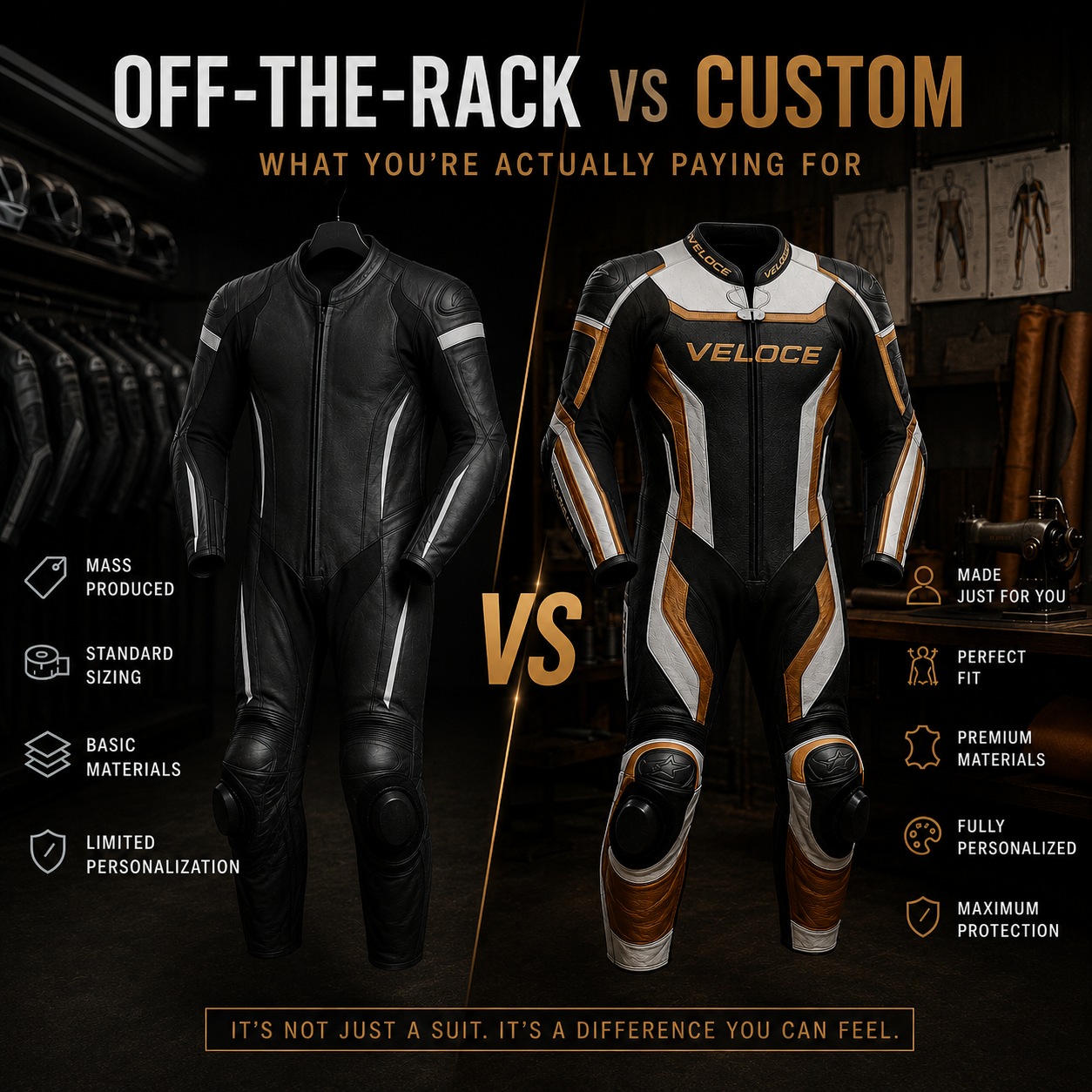
Every Veloce custom suit is built against a protection specification that we believe is the correct minimum for serious riding — not the regulatory minimum, and not the marketing minimum. Full-grain leather shell. CE Level 2 armour at all six impact zones. Pre-curved ergonomic patterning built around riding position. Triple-stitched seams on all structural panels. Kevlar-reinforced thread on high-stress zones.
Beyond the baseline, we work with each customer to specify upgrades that match how and where they ride — kangaroo panels for weight-conscious circuit racers, airbag-compatible construction for those who want the best available technology, perforated panels for warm-climate riders, and custom armour mapping for riders with specific impact zone concerns.
Protection is not an option on a Veloce build. It is the starting point. The custom design, the graphics, the colourways — those come after we know your suit will do its job if the day ever comes.