Not All Leather Is Created Equal
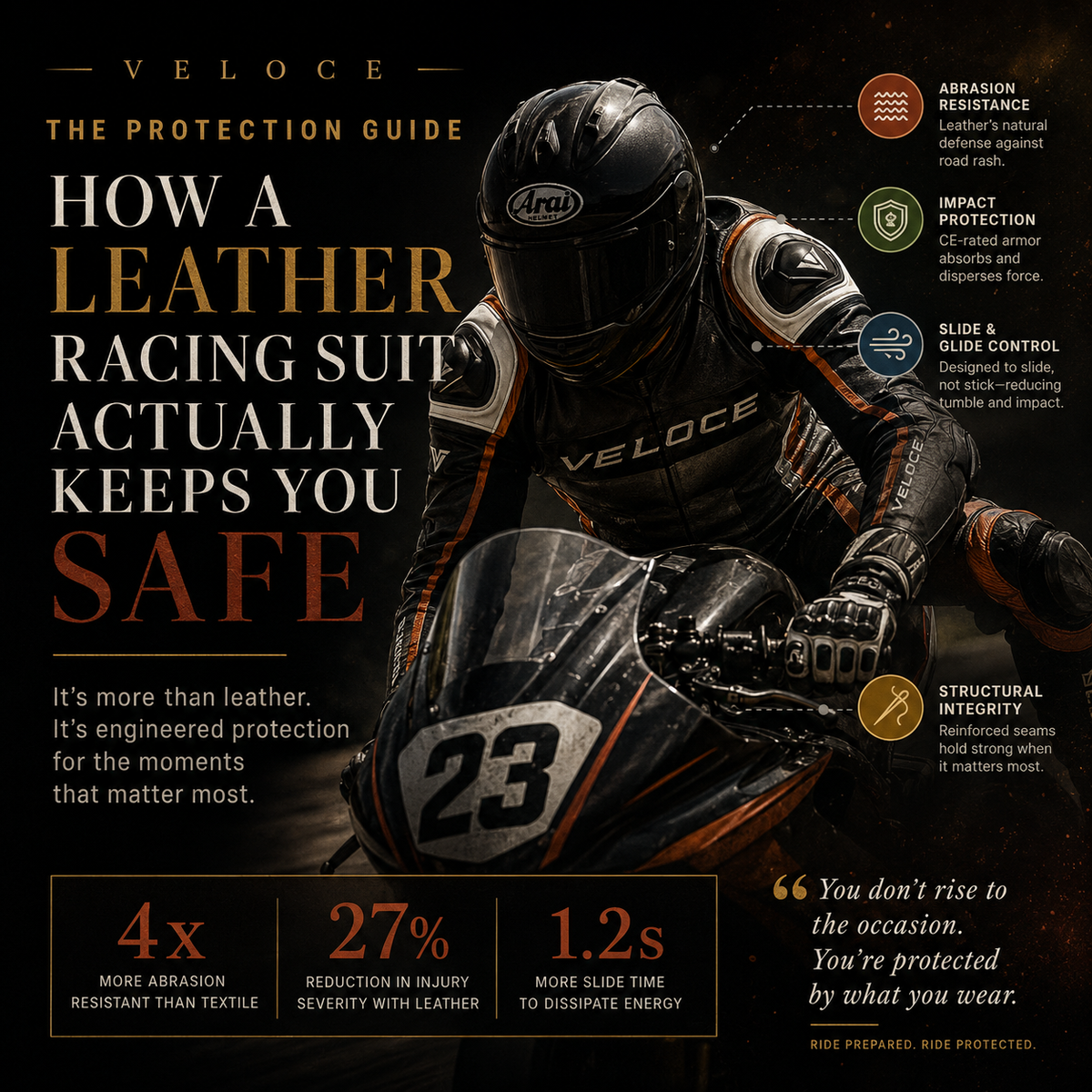
Walk into any serious racing paddock and look at what the fastest riders in the world are wearing. It is not textile. It is not synthetic. It is leather — the same material that has protected riders for over a century, refined into one of the most technically sophisticated protective materials available.
But the word "leather" covers an enormous range of quality, origin, and performance. A mass-produced suit and a hand-crafted Veloce commission may both carry the label — yet they are fundamentally different products. Understanding what separates them starts here.
"The leather on your suit is the last line of defence between your skin and tarmac. It deserves to be chosen with the same care as the armour beneath it."
Chrome tanning vs vegetable tanning — the two processes that define how leather performs on and off the track
How Leather Is Tanned Matters
Before we explore individual leather types, it helps to understand tanning — the process that transforms raw hide into a stable, usable material. The two dominant methods are chrome tanning and vegetable tanning, and they produce very different results.
Chrome tanning uses chromium salts. It is faster (24–48 hours), produces a softer, more supple leather that dyes easily and resists moisture well — making it the dominant choice for performance racing suits. Vegetable tanning uses natural plant tannins and takes weeks. The result is firmer and denser — exceptional for boots but rarely used for suit panels.
At Veloce, our suit leathers are chrome-tanned for optimal abrasion performance and fit. Our boot uppers blend both methods for the rigidity needed in ankle protection.
Six Types. One Standard — The Best.
A comprehensive breakdown of every leather type used in professional and custom racing gear manufacturing — from the most widely used to the rarest and most prized.
01 — Cowhide Leather
Industry StandardCowhide is the backbone of motorcycle gear manufacturing worldwide. Thick, durable, widely available, and offering excellent abrasion resistance at an accessible price point — cowhide forms the primary structural panels of a Veloce commission: chest, back, and thigh, where coverage and protection are paramount.
Full-grain cowhide retains the natural grain surface, making it the hardest-wearing option in this category. Split cowhide lacks this intact grain layer and performs measurably worse in slide tests — something we never compromise on.
- Thickness range in suits: 1.0mm – 1.4mm
- Excellent abrasion resistance over large panel areas
- Accepts sublimation printing and embossing well
- Ideal for jacket bodies and suit torsos
- EN 13595 Level 1 performance achievable at standard thickness
Full grain cowhide — the primary structural leather used in Veloce suit panels and jacket bodies
02 — Goatskin Leather
Gloves & Detail PanelsGoatskin is finer-grained, lighter, and more supple than cowhide — making it the material of choice for racing gloves, finger gussets, and sleeve cuffs. Despite its lighter weight, goatskin has a naturally tight fibre structure that delivers outstanding abrasion resistance pound-for-pound.
The Veloce Union Jack gloves in our Swiss project feature a perforated goatskin palm — chosen for the tactile feedback it gives on the throttle and brake levers. Riders who switch from cowhide gloves to goatskin consistently report feeling the bike more clearly through their hands.
- Tight, fine natural grain — excellent surface for custom graphics
- Breathes well even without perforation due to natural porosity
- Lighter than cowhide by approximately 20–30% at equal thickness
- Standard for MotoGP-grade glove construction
- Palm thickness: 0.6mm – 0.9mm / Back: 0.8mm – 1.0mm
Goatskin leather — the standard for MotoGP-grade gloves and Veloce's sleeve and cuff detail work
03 — Kangaroo Leather
Premium / MotoGP GradeKangaroo leather is the most technically impressive leather available for racing suit construction. Gram-for-gram, it is the strongest natural leather on earth — with tensile strength up to ten times that of cowhide at the same weight. This allows suit manufacturers to use thinner panels that weigh less without sacrificing protection.
At MotoGP level, kangaroo is the default specification for all factory race suits. At Veloce, we offer kangaroo-panel upgrades on full custom suit commissions for customers who want the same material specification as the fastest riders on the planet.
Kangaroo fibres run parallel to the skin surface in a uniquely consistent pattern — unlike cowhide where fibres are more random. This uniformity is why it abrades so cleanly without delaminating under sustained slide forces.
- Highest strength-to-weight ratio of any natural leather
- Thinner panel construction — improves aerodynamics and comfort
- Premium pricing reflects scarcity and processing complexity
- Available at Veloce as full-suit or key-panel upgrade
- Standard specification for all factory MotoGP suits
Kangaroo leather one-piece racing suit — lighter, stronger, and thinner than cowhide equivalents at every thickness
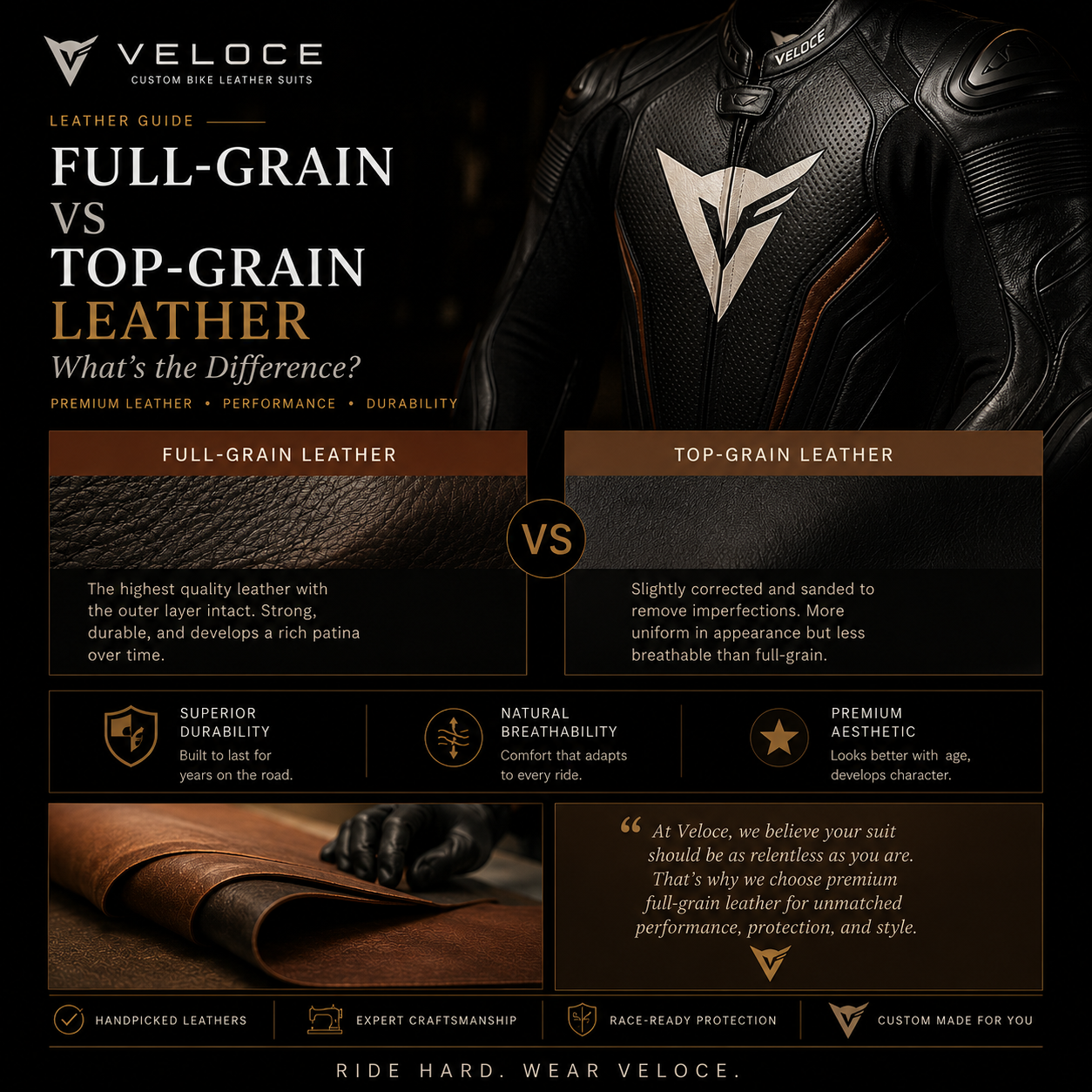
04 — Full Grain vs. Top Grain
Quality GradeThis is less a separate leather type and more a critical quality distinction within cowhide and goatskin — one that separates professional racing gear from consumer-grade products.
Full grain leather retains the entire original grain surface of the hide. It is the strongest, most durable layer and develops greater abrasion resistance over time. Top grain leather has had the surface sanded or buffed to remove imperfections — creating a uniform look but sacrificing the densest fibres in the process.
Corrected grain and bonded leathers have no place in protective racing gear. At Veloce, full grain is the minimum specification for all structural suit panels.
- Full grain: intact surface, maximum abrasion performance
- Top grain: buffed surface, reduced protection at same thickness
- Corrected grain: embossed to hide flaws — not suitable for racing
- Bonded leather: reconstituted scraps — never used in Veloce products
05 — Perforated Leather
Summer / Track Day SpecPerforated leather is full-grain cowhide or goatskin mechanically punched with a regular pattern of small holes — typically 2–4mm diameter — to dramatically improve airflow through the suit. The protective properties remain the same; only breathability changes.
The trade-off is a modest 10–15% reduction in abrasion resistance at perforated zones. Veloce perforated panels are always placed away from primary impact zones — shoulders, elbows, and knees retain solid leather regardless of spec.
- Ideal for summer circuits and track days above 20°C
- Perforation patterns: 2mm micro, 3mm standard, 4mm sport
- Perforated zones always mapped away from CE armour impact areas
- Available as a build option on any Veloce custom commission
Perforated leather panels — engineered ventilation without compromising the protective integrity of the outer shell
06 — Stretch Leather Panels
Comfort & Fit TechnologyModern racing suits incorporate zones of leather bonded to a stretch fabric backing — typically spandex or elastane — creating panels that move with the rider's body. These are placed at the inner thigh, behind the knee, and across the waist — areas that flex continuously through a full riding position.
The stretch backing does not reduce the protective value of the leather outer layer. It eliminates the binding that traditional suit designs create when a rider drops to a racing crouch — making a suit that fits in the saddle, not just standing up.
- Standard placement: inner knee, seat, waist gusset, armpit gusset
- Leather outer retains full EN 13595 compliance in stretch zones
- Custom stretch panel mapping available on bespoke Veloce builds
- Paired with pre-curved construction for riding-position fit
Leather Comparison
How the principal leather types compare across the metrics that matter most for racing suit use.
| Leather Type | Abrasion | Weight | Typical Use | Veloce Use |
|---|---|---|---|---|
| Cowhide — Full Grain | Heavy | Suit torso, jacket body, boots | Primary panels, all suits & jackets | |
| Goatskin | Light | Gloves, cuffs, fine detail panels | All Veloce gloves & sleeve details | |
| Kangaroo | Lightest | MotoGP race suits, premium builds | Available as panel upgrade option | |
| Full Grain (Grade) | Standard | Any structural panel use | Minimum standard at Veloce | |
| Perforated Leather | Standard | Summer suits, track day builds | Optional upgrade, non-impact zones | |
| Stretch Leather | Light | Flex zones, inner panels | Standard on all Veloce suit builds |
How We Choose Leather for Every Build
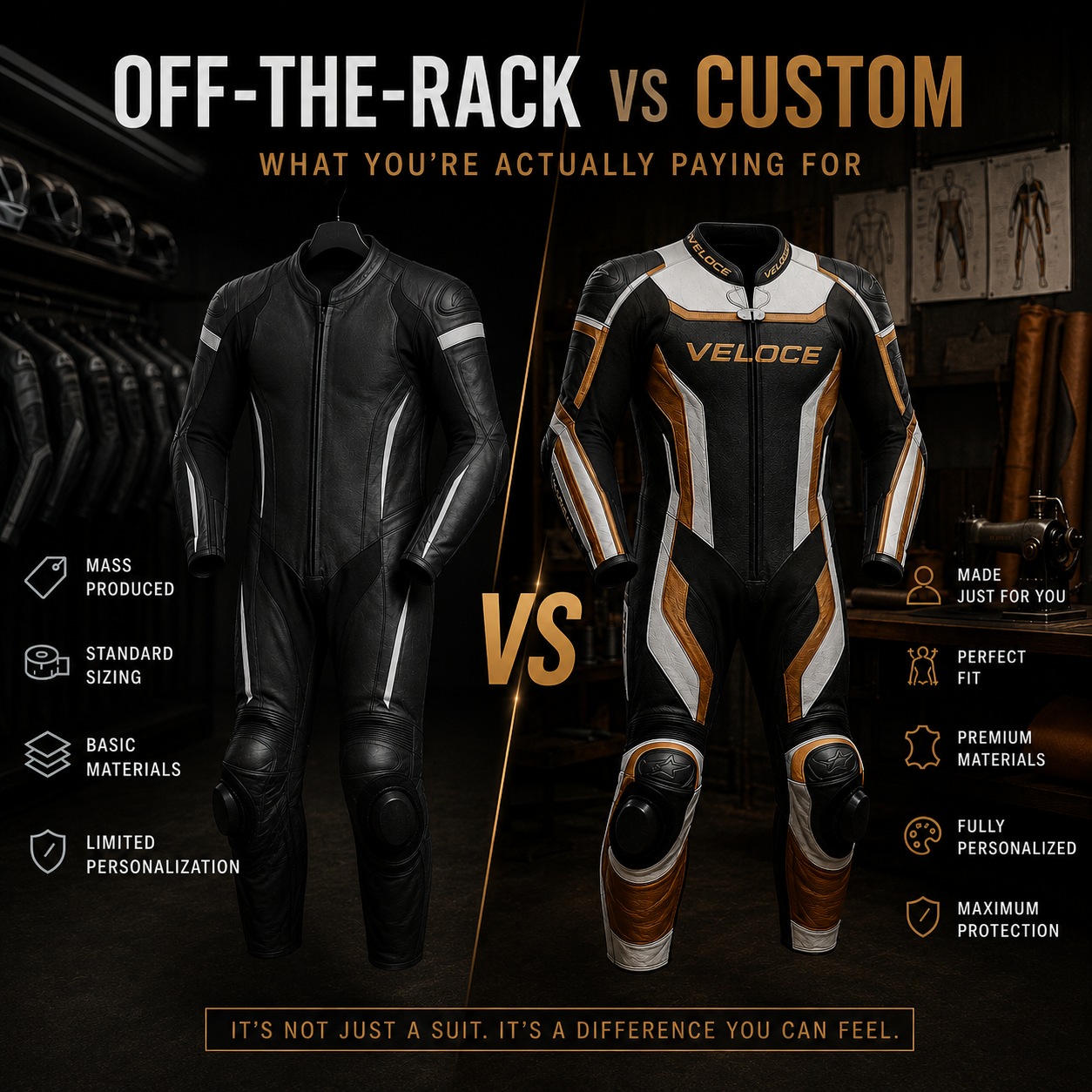
At Veloce, every custom commission begins with a leather selection conversation. What circuit or road will you be riding? What climate? Do you prioritise absolute protection, light weight, or that unmistakable worn-in feel of premium full-grain hide? These questions directly determine which hides we pull from stock and how we pattern your suit.
Our baseline is always full-grain chrome-tanned cowhide at 1.2mm minimum on structural panels. From there, we layer in goatskin where suppleness matters, stretch panels where freedom of movement demands it, and kangaroo where a customer wants the very best protection-to-weight ratio available anywhere.
Every Veloce suit ships with a leather specification card documenting the exact hide grades, tanning method, panel thicknesses, and abrasion test results used in your build. Because when you go down on track, you deserve to know exactly what stands between you and the tarmac.