The Question Behind the Question
When a rider asks what their suit is made from and the answer comes back "genuine leather" or simply "leather," that answer tells them almost nothing. Leather is a category, not a specification. Within that category sits a range of quality so wide that the best and worst products share almost nothing in common except the raw material they started from.
Full-grain and top-grain are the two grades most relevant to motorcycle gear — specifically to suits, jackets, gloves, and boots where abrasion resistance, tear strength, and long-term durability determine whether the gear does its job in a crash. Understanding the difference between them is not a matter of preference. It is a matter of knowing what you are trusting your skin to.
This guide explains both grades clearly — what they are, how they are produced, how they perform, and what they mean when you are choosing or commissioning motorcycle gear.
"Ask any leather craftsman which grade they would choose for gear they had to wear themselves. The answer is always the same. Full-grain. Every time."
Full-grain cowhide — the intact natural surface of the hide, with every grain, pore, and marking preserved exactly as nature produced it
How a Hide Is Structured — and Why It Matters
Every piece of leather begins as an animal hide. That hide has a natural structure — layers with fundamentally different properties stacked from the outer grain surface down to the flesh side. The grade of the finished leather is determined by which layers are retained, which are removed, and how the remaining surface is treated.
The outermost layer — the grain surface — is the densest, most tightly interlocked part of the hide. The fibres here are packed closely together in a complex three-dimensional weave that gives the leather its abrasion resistance, its tear strength, and its ability to flex without cracking. As you move deeper into the hide, the fibre structure becomes progressively looser and weaker. The flesh side of a hide is far less resistant to abrasion than the grain side.
This is the single fact that determines everything else in this guide: the grain surface is the strongest part of the hide, and any manufacturing process that removes, reduces, or compromises that surface reduces the leather's protective performance proportionally.
Cross-section of a cowhide — the four leather grades mapped to the layers they come from, from the protective grain surface to the weakest flesh side
Full-Grain Leather — The Uncompromised Hide
What It Is
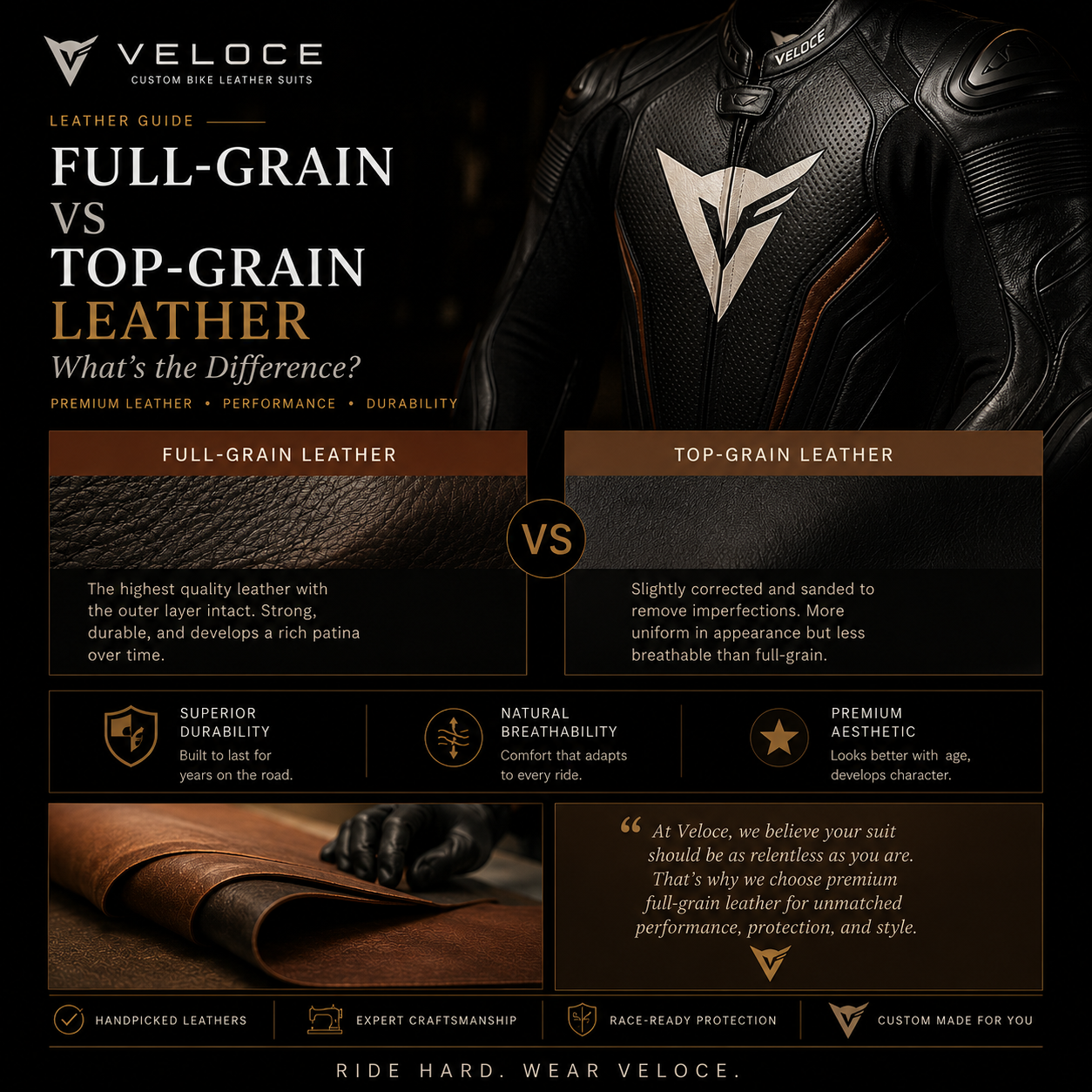
Veloce StandardFull-grain leather retains the complete, unaltered grain surface of the hide. Nothing is sanded away. Nothing is buffed. Nothing is embossed over the top. The surface you see on a full-grain piece of leather is the surface the animal had — every natural marking, every pore, every variation in the grain pattern preserved exactly as it was.
This is not a sentimental choice. The intact grain surface is the densest, most abrasion-resistant part of the entire hide. Removing any of it — even fractions of a millimetre — reduces the leather's protective performance. Preserving all of it gives you the maximum protection that hide can offer.
How It Performs Over Time
Improves With UseFull-grain leather develops a patina — a deepening of colour and surface character that comes from use, conditioning, and the natural oils the leather absorbs over time. Crucially, this patina is not a sign of wear. It is a sign of the grain fibres becoming even more densely consolidated at the surface. A well-maintained full-grain suit after three seasons of hard use is more abrasion-resistant than it was when new.
This is the opposite of what happens with top-grain and lower-grade leathers, where the artificial surface coating breaks down progressively with use, exposing progressively weaker layers beneath.
- Intact grain layer — maximum abrasion resistance from day one
- Develops patina with use — surface strength increases over time
- Natural pore structure breathes better than coated alternatives
- Absorbs and retains conditioning oils — stays supple longer
- Natural grain markings mean every hide is visually unique
- The standard for all structural panels in every Veloce build
Top-Grain Leather — Corrected for Appearance
What It Is
Corrected GradeTop-grain leather starts from the same part of the hide as full-grain — the grain surface. The difference is what happens next. The hide is fed through a buffing or sanding machine that removes the uppermost layer of the grain surface, eliminating natural scars, insect bites, growth marks, and any other imperfections the animal carried during its life.
Once the natural surface is removed, an artificial grain pattern is embossed onto the now-smooth leather, and a surface coating — typically polyurethane — is applied to give the finished product a consistent, uniform appearance. The result looks clean and even. It photographs well. It displays well on a shop rail. And it performs measurably worse than full-grain leather in the conditions that matter.
The Performance Compromise
Lower ProtectionThe sanding process that makes top-grain look uniform removes exactly the part of the hide that provides the most protection — the densely interlocked fibres at the outermost grain surface. The depth removed is typically 0.1mm to 0.3mm, which sounds negligible. At the grain surface, where fibre density is highest, it is not negligible. Studies of abrasion test results for protective motorcycle gear consistently show measurable performance reduction in top-grain leather versus full-grain at equivalent thickness.
The polyurethane coating that replaces the natural surface also degrades with use. Unlike full-grain leather which strengthens with conditioning and wear, top-grain leather's surface breaks down progressively — exposing the weakened layer beneath and reducing protective performance over the life of the garment.
- Natural grain surface removed — reduced abrasion resistance versus full-grain
- Artificial embossed grain applied over sanded surface — cosmetic, not structural
- PU surface coating degrades with UV exposure, flexing, and cleaning
- More uniform appearance — imperfections removed before coating
- Lower cost than full-grain — the economic reason it is used at mid-market price points
- Performance gap widens over time as coating breaks down
Full-grain, top-grain, and genuine leather side by side — the natural grain surface becomes progressively more processed and less protective moving right
Full-Grain vs Top-Grain — The Direct Comparison
Every metric that matters for motorcycle gear protection, durability, and long-term value — compared directly.
The Other Two Grades — and Why They Don't Belong in Your Suit
Full-grain and top-grain are the two grades relevant to quality motorcycle gear. Below them sit two further categories that are worth understanding — primarily so you can recognise them and avoid them.
Genuine Leather — Split Grade
Not Suitable for Protective Gear"Genuine leather" is one of the most misleading terms in the industry. It sounds like a quality claim. It is actually a grade designation — and a low one. Genuine leather is typically produced from the split layer of the hide: the section left over after the grain surface has been separated for full-grain or top-grain production.
The split layer has a loose, open fibre structure with substantially lower abrasion resistance and tear strength than the grain layers above it. It is real leather — hence "genuine" — but it is the weakest structural layer of the hide. Products labelled "genuine leather" that appear in motorcycle gear at very low price points are frequently built from this split grade, with a spray-on surface finish to mimic the appearance of higher grades.
Bonded Leather — Reconstituted Material
No Place in Protective GearBonded leather is not, in any meaningful sense, leather. It is manufactured by grinding leather scraps and fibres — the waste material from the production of higher-grade hides — into a pulp and bonding that pulp with polyurethane on a fibre backing sheet. The result contains leather content but has none of the structural properties of a real hide.
It will pass basic appearance tests. It will not pass abrasion tests relevant to protective gear. It delaminates under sustained abrasion — the outer layer separates from the backing — and provides essentially no protection in a real crash scenario. Any product claiming leather construction at an implausibly low price point is almost certainly using bonded leather for at least some panels. Veloce does not use it anywhere.
What the Difference Means at Speed
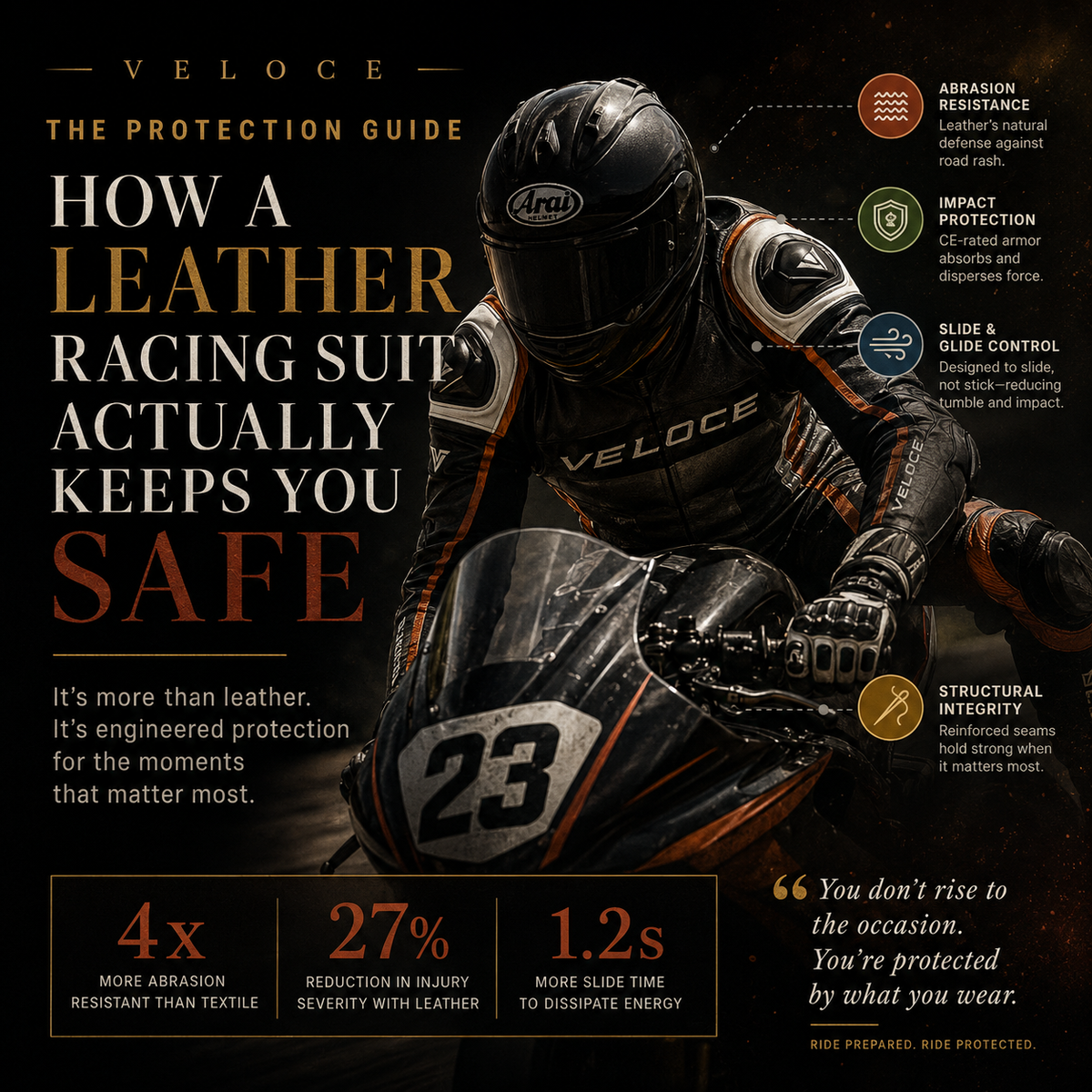
Laboratory abrasion test numbers are useful reference points. What they represent in practice is this: in a real slide at 70–80km/h, a full-grain leather suit panel will sustain abrasion for longer before breach than a top-grain panel of the same thickness. How much longer depends on the specific hides and thicknesses involved — but the direction of the difference is consistent and the physical reason for it is clear.
The skin underneath is not abstract. A shoulder, a hip, a knee contacting tarmac at circuit speed without the leather panel holding is an injury that changes lives. The margin offered by the stronger material is not guaranteed protection — no gear provides that — but it is a real margin, and in protective equipment that margin is exactly what you are paying for.
The Cambridge Abrasion Test — the standard method used to measure how long a leather panel holds before breach under sustained abrasion at speed
Myths About Leather Grades — Busted
Several persistent misconceptions about full-grain and top-grain leather circulate in gear reviews and shop conversations. Here is the accurate position on each.
"Top-grain looks more uniform, so it must be better quality"
Uniformity in top-grain leather is achieved by removing the natural surface and replacing it with an embossed artificial pattern. It looks consistent because the character has been sanded off. Full-grain leather looks varied because it is showing you the actual hide — which is a sign of authenticity, not inconsistency.
"A thicker top-grain suit is safer than a thinner full-grain suit"
Thickness alone does not determine protective performance. A 1.4mm top-grain panel may perform comparably to — or worse than — a 1.2mm full-grain panel, because abrasion resistance is determined by fibre density at the surface, not overall thickness. Thickness matters; grain integrity matters more.
"You can't tell the difference between grades once the suit is made"
You can. Full-grain leather breathes noticeably better, conditions more deeply, and develops visible patina over time. Top-grain leather with degrading coating shows surface cracking, peeling, and colour loss that full-grain simply does not. The difference becomes clearer — not less clear — with use.
"Full-grain leather is harder to source and costs more"
This is accurate. Full-grain hides must be selected from animals with fewer surface imperfections, because those imperfections will be visible in the finished product. The rejection rate is higher, the selection process is more demanding, and the cost per usable panel reflects that. This is why the grade differential exists in finished product pricing.
"Proper conditioning matters more for full-grain than top-grain"
Also accurate. Full-grain leather's open pore structure means it absorbs conditioning oils deeply — and benefits significantly from regular conditioning. Top-grain leather's PU coating limits how much conditioner can penetrate. This is actually an argument for full-grain: the investment in proper care produces tangible, measurable improvements in performance and lifespan.
How to Identify the Grade Before You Buy
Manufacturers are not always forthcoming about which leather grade their gear uses — particularly at mid-market price points where the distinction is most commercially sensitive. Here are the practical tests that help identify grade without laboratory equipment.
- Look at the grain pattern variety. Full-grain leather shows subtle variation across the panel — grain patterns that shift slightly, areas of finer and coarser texture. Perfectly uniform grain across an entire panel almost always indicates embossing on top-grain or lower.
- Check how it responds to moisture. Place a drop of water on a hidden area. Full-grain leather absorbs it gradually, darkening slightly at the contact point. Top-grain leather with PU coating beads the water — the coating prevents absorption.
- Ask for the specification in writing. A manufacturer confident in their material will tell you the grade, the tanning method, and the panel thickness without hesitation. Vague answers about "premium leather" or "high-grade cowhide" without grade specification are a signal worth noting.
- Check the smell. Full-grain leather has a distinctive natural hide smell — earthy and rich. Heavy chemical odour or the smell of synthetic coating is more characteristic of top-grain or lower-grade materials.
- Look at the underside of panels where possible. Full-grain leather shows a consistent flesh side. Lower grades show bonding lines, backing fabric, or inconsistent texture on the reverse.
Our Position — and Why We Hold It
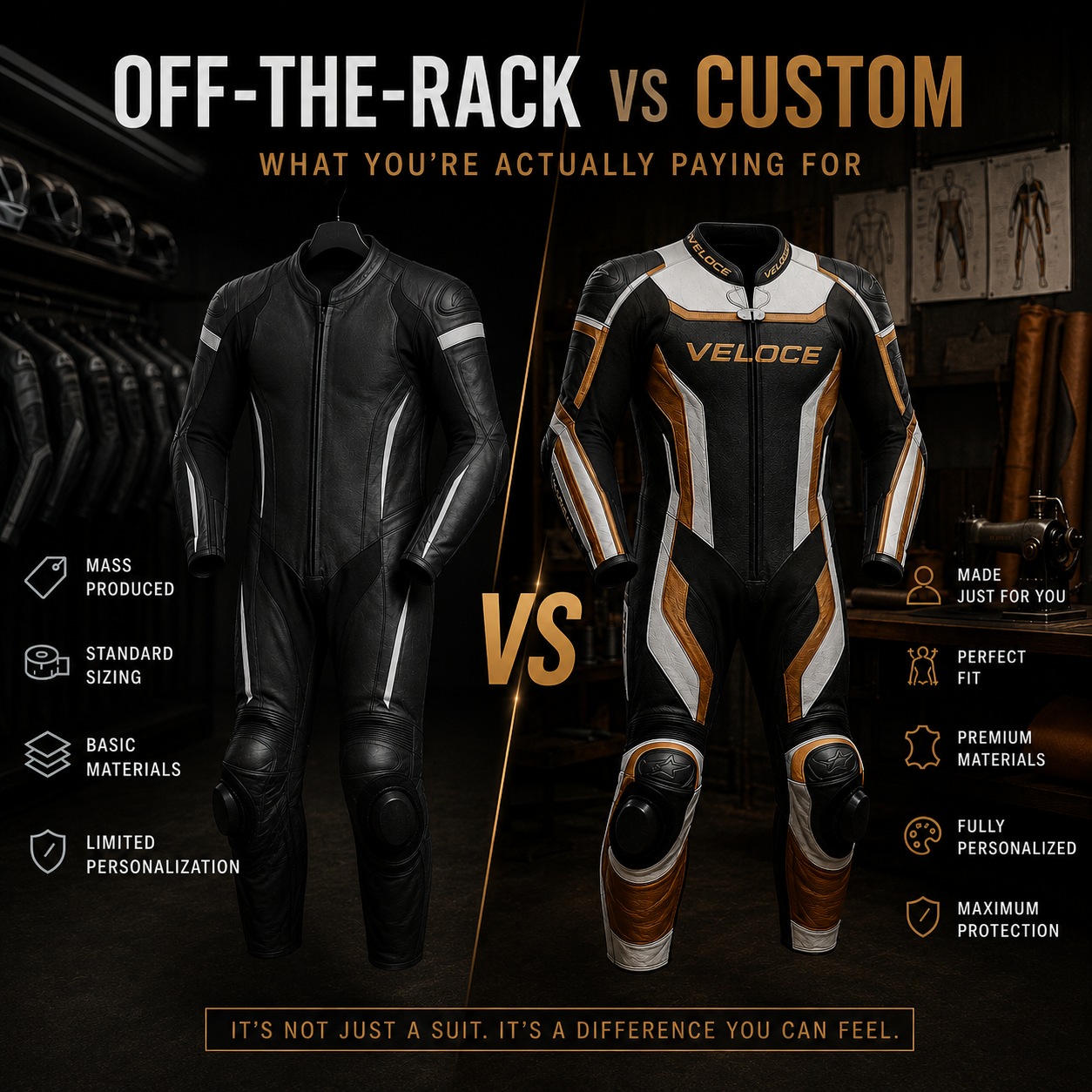
Veloce uses full-grain leather as the minimum specification for all structural panels in every suit, jacket, glove, and boot we build. This is not a marketing decision. It is the only defensible position for a manufacturer building gear that people depend on in a crash.
We could use top-grain leather on non-visible panels and reduce our material costs meaningfully. We choose not to, because the rider wearing our gear cannot see those panels in a crash, and neither can we. The standard has to hold across every panel, not just the ones that will be photographed.
Every Veloce commission ships with a leather specification card documenting the grade, tanning method, origin, and thickness of every panel used in the build. If the grade is not in writing, it is not our standard.
- Full-grain chrome-tanned cowhide on all structural suit and jacket panels
- Full-grain goatskin on all glove constructions — palm and back
- Kangaroo available as a full-suit or panel upgrade — always full-grain
- No top-grain, split, genuine, or bonded leather used on any protective component
- Leather specification card included with every completed commission
Full-grain cowhide construction throughout — the visual variation across panels is not inconsistency, it is the natural hide speaking for itself